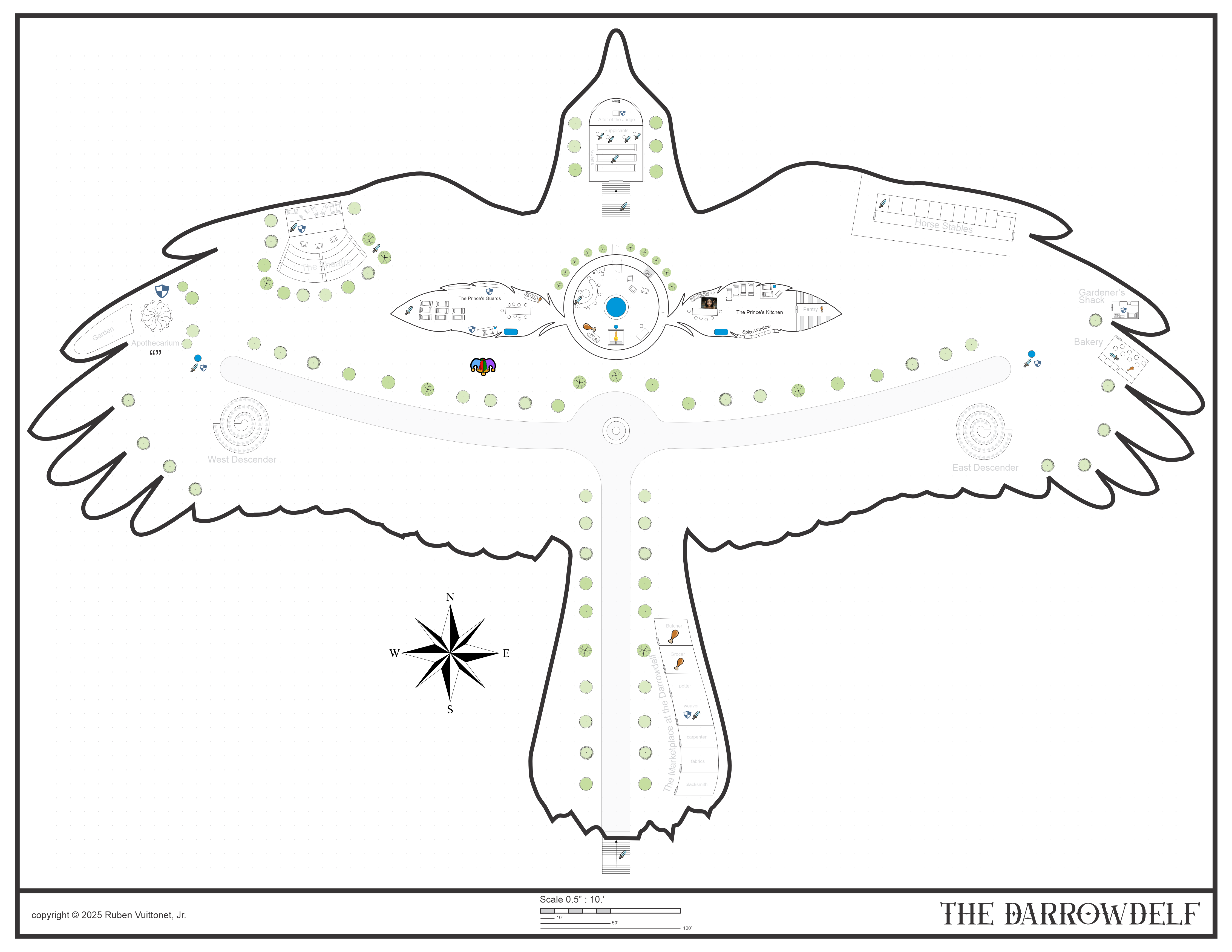
“Darrow” is the self-assigned name of the Darrow tribe. “Delf” means “home.” An aerie is the large nest of a large bird. Hence, the name of the dungeon: The Darrowdelf: Aerie.
The Darrow maintained a long-enduring and thriving civilization dedicated to their gods, loving of their environment, and holding ultimate respect for the bird they believed embodies their ideals: the crow. Though forced underground many years ago, they maintain themselves as wood elves and dress appropriately.
There had been whispers of a grudge, of an enmity so strong it longed for the desecration of the Darrow.
The prince thought it prudent to hope for the best but plan for the worst. He fabricated powerful artifacts for the preservation of his people and placed them where he thought best. The question is, were those thoughts his best thoughts.
And then, one day, it happened. No one was exactly sure what happened, even though something clearly had. The Darrow were all missing. Their homes, businesses, restaurants, and other venues were all but abandoned.
The Darrow live in a region of the Darrow Mountains in a widespread underground collection of villages, towns, and cities. These civil entities are connected by a vast web of tunnels. Where the Darrow have access to the outside, which they love, they farm in valleys over which they have full authority. They also farm on the mountainsides, where possible.
The women of the Darrow are rarely seen but are known to be as active in their communities as are the men. They are also fierce warriors and, as a last resort, issue into combat to avert dire threats. The Darrow, as a result of abiding underground for centuries, are very pale-skinned with large, clear, blue, green, or hazel eyes. As elves, they tend toward the thin side.
Religion
The Darrow religion is animist. That is, they believe that souls reside in the bodies of both humanoids and animals. Further, they especially believe that crows are the reincarnation of former Darrow. Their society emulates what they see in crow behavior. They work together as a flock, but are not overly helpful to others, feeling free to scavenge (some call it stealing) from them as opportunities arise, much as a carrion crow feeds from carrion as it is able. In this respect, the Darrow are very much like gypsies, except they live in fixed locations and do not travel about.
The Prisms
The apothecary created a set of artifacts (6 prism slices, a prism holder, and a prism projector) as a safeguard against attack from an enemy he became aware of in a vision. These artifacts figure very prominently in this adventure. They were, originally, given to 6 different people, each aware of all the others. The “event” left only two people around who know the recipients. Neither one nor the other knows all of them. These are the apothecary and Rifarín, the prince’s niece.
Eventually, when the prisms are combined and should be projected onto someone’s chest, it is important to note that the volunteer will die when the projection happens. Ossorg Osan’s plan is to have the prince volunteer and die, thus avenging the deaths of his villagers years ago.
When the Darrow People were translated into a different dimension, various monsters and/or people were translated to the Aerie as impediments to any quest to restore the Darrow. They will be encountered as the company attempts to find a solution to The Event.
When play starts, all of the Darrow have disappeared. Homme Outil was hired by Prince Nifardín to compose a team of adventurers to investigate the Darrowdelf Aerie and, if possible, rectify the situation. Their first efforts must, necessarily, revolve around finding out what happened.

Nifardín, or “The Prince,” is the Crown Prince of The Darrow. As a result, he resides in the traditional estate of The Darrowdelf Aerie, an inaccessible plateau in The Darrow Mountains, shaped, by great labor of old, into the shape of a crow.
At the time of the event, Nifardín was the epitome of a refined, generous, diplomatic, and chivalrous prince, with great compassion for people. In his youth, he was not so. During a tenure in a human village, then, he fell in love with a young human woman. When he resolved to return to his people, she resolved to stay in her village, not wanting to forsake her family and friends. He beat her rather severely, causing her death. The villagers rose in anger, intending to hang the prince. Naso Grosso, the village’s apothecary, just happened to return to town at that moment. Fearing a war with the Darrow, he hastily cast too strong a spell, killing many of his village’s people. For saving him, the prince took Naso as his apothecary.
Afterward, guilt influenced the prince to live a life of more gravitas. He set aside arrogance, preferring to administer to family, friends, and the Darrow people with less selfish motivations.
The end game for the Darrow’s enemy is the sacrifice of the prince to save his people. Ossorg Osan expects both the prince's guilt and Rifarín’s anger to motivate him to volunteer for the sacrifice. This will not come to pass if his granddaughter does not bless the reconstituted Prism to release its power. The truth of the prince's relationship with her grandmother and her grandmother’s death at Nifardín hands will be made known to her ere the prism is projected onto the chest of a volunteer. Of course, she is a kind, peace-loving child, so she is reluctant to allow the Darrow people to remain in limbo simply to spite her “uncle”—even though she is well aware leaving them in limbo is a powerful way to harm the prince.

Rifarín is a small, elvish girl with a small nose and big blue eyes. She looks completely elvish but is only one-quarter elf. She was staying at her uncle’s (the Prince) for the summer because of tensions over her “tainted” heritage. When almost everyone disappeared, she was left behind. She knows that her uncle spent much time with various people before the event but is very shy and must be coaxed to give up that or any other information. In fact, she does not know all the people to whom her uncle spoke. In the plan, being the only elf of royal extraction remaining, she must bless the prism before its use.
Rifarín is the granddaughter of the prince from a relationship the prince had with a human in a village when he was young. Nifardín killed her grandmother, forcing the apothecary of that village to save the prince from a lynch mob. The apothecary, because he was shunned for the way he saved the prince, became the prince's apothecary and moved to The Darrowdelf. When his granddaughter was abandoned to the elves, the prince arranged for her care.
The human woman with whom Nifardín had a relationship was pregnant when he beat her. She gave birth after the assault. The child lived. She did not. Much later, she would have a daughter who would, in turn, have a daughter. Rifarín. Despite her mother living among humans her entire life, Rifarín was abandoned by her human village because of its fear of elves. She was taken to the border between human settlements and the Darrow and left there. The prince, hearing of the little girl’s travail, had a family of royal descent adopt her. She knows the prince as an “uncle,” which, of course, is what she calls him.
When the situation comes to a head in The Darrowdelf Aerie, Rifarín will be made aware of her history. Her anger will be such that she will not place a blessing upon the Prism to activate its power. All will hang in the balance of a little elf girl’s handling of the revelations about her grandmother.
Nifardín is not married and has no recognized children. The end of the adventure, if everything goes according to Ossorg Osan’s plan, will find the prince dead and Rifarín Crown Princess in his stead.

Big nose in Italian. Naso Grosso is the apothecary for the prince. He was once the apothecary for a small human village, though his abilities could have easily earned him a position at any royal court. The prince, sowing his wild oats, as it were, resided in the village for a time while he dated a young human woman. When he was ready to return to his people, she would not agree to join him, so he beat her severely. She died, though the prince and her as yet unborn child did not. The village arose in protest, intending to lynch the prince.
Naso Grosso, having been out of town, found himself returning just as these events were unfolding. Fearing a war with the Darrow, he panicked and cast too strong a spell. Many of the villagers died. Knowing they could not defeat him, the people of his village chose to banish him instead.
The prince, in fear for his life, took Naso Grosso as his apothecary. Naso, finding himself homeless, moved to the plateau of the Darrowdelf Aerie, remaining with the Prince from that time forward.

Shot foot in French. The captain has been the leader of the guard contingent on the Darrowdelf Aerie for many years. He has long, gray hair kept in a ponytail. Rather than wearing tokens of rank or position, he dresses as a typical Darrow soldier in woodland clothes of dark green and leather. He carries a bow and fighting knives. He is not Legolas.
His love of The prince is very deep and abiding. Because of this love, it is not possible, therefore, to draw the prince to a place without also drawing the Captain.
At the end of the adventure, when the prince is drawn back to the Hall of Supplication, the Captain is also drawn back. He will have a role to play in the final scene, though what that might be is left to the
Dungeon Master. If Nifardín dies, the captain will immediately take Rifarín into his protection.

Kitten in French. Chaton is a cat. And, as such, he does not really care about anyone except himself. He will follow outsiders around, frequently meowing vociferously when it might be the least advantageous to those whom he is following.
There is a d20 >= 11 (55%) chance that Chaton will meow when the adventurers enter an area where an attack might be imminent.

A play off of “rover.” Rofer is The Prince’s dog. He is a pleasant, obedient, and friendly sort of animal. His only weakness is Chaton, whom he despises. He is given to attacking the cat at any time he feels he can get hold of him. Except he cannot. The cat is always too swift, avoiding injury by quick reflexes and an instinctive sense of which way to jump and when.
When approaching an area of possible attack, there is a 25% chance that Rofer will attack Chaton, thus alerting any monsters of their approach.

Tool Man in French. Homme Outil is a human agent in the human-populated Crow’s Perch village hired by the Prince to arrange a team of adventurers who, whether for fame, or fortune, or charity, might help The Darrow. He is employed at the Crow Stables, a local housing for 10 ’crows used as taxis both to and from Crow’s Perch to The Darrowdelf Aerie.
Homme was, in no way, shape, or form, informed of the nature of the potential threat to The Darrow. Nor was he informed of the Prism, its slices, or their use. He is simply an honest man in whom the prince placed his trust to find a team to address The Darrow’s needs in the event of an emergency.
He may join the adventurers. It is up to them. Homme has no experience either with The Darrow or with pursuing quests. He is simply keen to find out what caused the event.
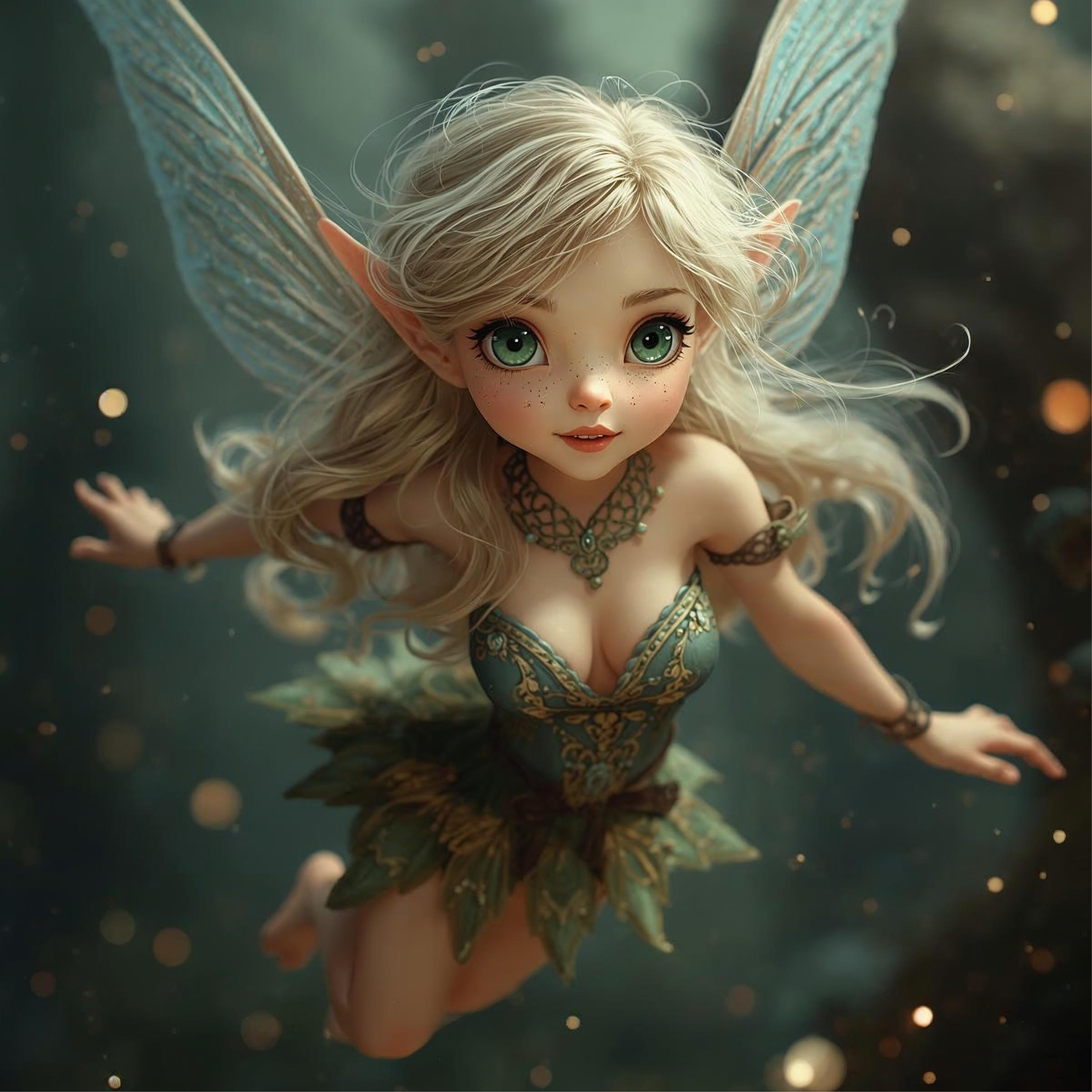
The pixie lives in the Hall of Supplication, where Rifarín discovered her shortly after she arrived to visit her ‘uncle.’ Like most pixies, she is good-natured but loves to play tricks and pranks on others. In fact, she is more good-natured than most pixies.
The plight of the Darrow has upset Pixie to such an extent that, in the final scene of the dungeon, the pixie will try to influence Rifarín to kill her uncle, despite Rifarín’s ambivalence about hurting him.
Will she succeed? Time, and, perhaps, a roll of the dice will tell! d20 > 20 (100%)